What Fleetwood Mac, Dennis Rodman and the science of team performance can teach us about relationships, alignment and working together.
By Jeff Lancaster | Founder, Changefully & Teamfully
In 1976, five musicians entered a recording studio in California.
Two were separating. Another couple's relationship had collapsed. The drummer was dealing with the breakdown of his marriage.
They argued. They disagreed. Some of their personal relationships were barely functioning.
And together, they created one of the most successful albums in music history.
The band was Fleetwood Mac. The album was Rumours.
Released in 1977, it became a commercial and critical phenomenon, winning the Grammy for Album of the Year and producing songs that remain familiar nearly fifty years later.
It's a remarkable story of creative achievement amid interpersonal turmoil.
But it also raises an interesting question.
Do people actually have to like each other to perform exceptionally well together?
I don't think they do.
And after years of working with athletes, coaches and teams, I've become increasingly interested in the distinction between the relationships people have and the performance they're capable of producing together.
Because they're not necessarily the same thing.
The Dennis Rodman problem
In 1995, the Chicago Bulls acquired Dennis Rodman.
For Michael Jordan and Scottie Pippen, this wasn't simply another talented player joining the roster.
Rodman had been part of the Detroit Pistons teams that made life extraordinarily difficult for Chicago. Their encounters had been physical, confrontational and, at times, deeply hostile.
Now they were expected to become teammates.
Rodman's competence wasn't in question. He was an exceptional rebounder and defender.
But competence alone wouldn't make the arrangement work.
He needed to contribute those abilities to Chicago's ambitions. Jordan and Pippen needed to accommodate his strengths. They needed to collaborate, establish sufficient mutual trust and commit to something beyond their previous differences.
The Bulls won three consecutive NBA championships between 1996 and 1998.
Did Jordan and Rodman become best friends?
That wasn't the requirement.
They needed to become effective allies.
And I think there's something important in that distinction.
The Four As: Not every relationship needs to become a friendship
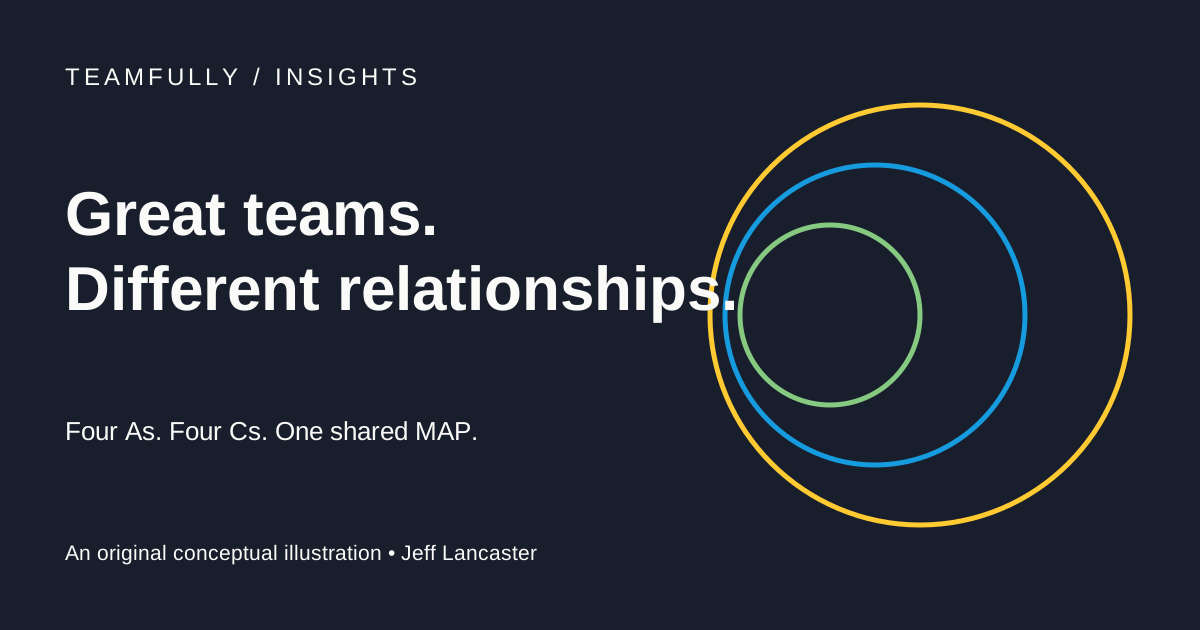
I've been developing an approach to understanding relationships through what I call the Four As.
Acquaintances. Associates. Allies. Advocates.
Acquaintances are people we recognise or know, but with whom we have limited relational involvement.
Associates are people connected through shared activities, circumstances or responsibilities. We might work together, train together or belong to the same organisation.
Allies are people with whom we establish a meaningful mutual commitment. We stand together for something that matters, support one another and can depend on each other in pursuit of a shared purpose.
Advocates represent a deeper, more personally invested relationship. These may be our closest friends, intimate partners or family members. The commitment extends beyond a particular task, project or mission.
These aren't developmental stages.
Relationships can change. People can move between circles. And different circumstances may create different kinds of commitment.
Importantly, Advocate isn't necessarily the destination.
Consider military alliances. Countries with vastly different political systems, interests and histories may cooperate in pursuit of a shared mission. Their alliance can be genuine, consequential and highly effective without becoming permanent.
The same applies to teams.
A colleague can remain an Associate for twenty years and make an extraordinary contribution. Two people can become Allies for a six-month project and go their separate ways afterwards.
And two close friends can be Advocates for one another while making terrible business partners.
The depth of a relationship doesn't automatically determine the quality of collective performance.
The Four Cs: What makes working together work?
This leads to a second part of the approach.
I believe there are four particularly useful dimensions to examine when understanding how teams function.
Competence. Contribution. Collaboration. Connection.
They sound similar in places, but the distinctions matter.
Competence — What are we capable of?
Competence encompasses the knowledge, skills, judgement and adaptability required to meet the demands we face.
In many high-performance environments, competence is the gateway. Athletes are selected, musicians audition and professionals are recruited because they demonstrate a required level of capability.
But assembling competent individuals doesn't automatically create a competent team.
Contribution — What do we actually bring?
There's a difference between possessing capability and applying it.
Two people may have comparable abilities but make very different contributions.
Contribution includes the application of effort, initiative, expertise and responsibility to the collective endeavour.
And it isn't always visible in conventional performance statistics.
The player who creates space, the colleague who prevents a costly mistake, or the musician who knows when not to play may contribute enormously without attracting attention.
Collaboration — How do we combine our contributions?
Collaboration is the process through which individual contributions become collective work.
It requires coordination, communication, adaptation and the ability to manage differences.
An outstanding collection of individuals can still produce an ordinary team if they cannot combine their capabilities effectively.
Connection — What binds us together?
Connection encompasses the relational qualities that support our interactions: trust, respect, care, closeness and commitment.
But here's an important distinction.
Connection doesn't necessarily mean friendship.
A professional relationship can involve meaningful trust, mutual respect and shared commitment without deep personal affection.
And the amount and type of connection required will depend on the work being undertaken.
A surgical team assembled for a single procedure may need a different kind of connection from a military unit deployed together for months.
Both need relationships that support the demands of their work.
What does the research tell us?
There is a substantial body of research supporting the importance of these underlying dimensions.
Mayer, Davis and Schoorman's influential 1995 model of organisational trust identifies ability, benevolence and integrity as important contributors to perceived trustworthiness.
That distinction matters. Recognising someone's competence isn't the same as believing they'll act with goodwill or integrity.
Amy Edmondson's 1999 research on psychological safety demonstrated important relationships between team psychological safety, learning behaviours and performance.
Psychological safety doesn't require everyone to be friends. It concerns whether people believe they can take interpersonal risks—such as asking questions, admitting mistakes or challenging ideas—without being punished or humiliated.
Research on team processes also shows that collective performance depends on more than individual talent. Coordination, communication and the management of interdependent work matter.
None of this establishes that every team needs equal amounts of the Four Cs, or that the Four As are scientifically validated categories.
But it provides a strong foundation for examining how relationships, capability and collective behaviour interact.
And it challenges a persistent assumption.
A closer team isn't necessarily a better-performing team.
Where purpose changes the relationship
There's another element I've found important in my work with teams.
Alignment.
Not simply agreement on goals, but clarity about why we're together, how we'll behave and what will guide those behaviours.
I use a framework called MAP.
Mission — our purpose.
What are we fundamentally pursuing? Not simply the result we want to achieve, but the purpose that gives our collective effort meaning.
Approach — our behaviours.
How will we behave in pursuit of that mission? What will people actually see us doing?
Principles — our values.
What values underpin and guide those behaviours? What boundaries are we unwilling to cross?
These distinctions matter because teams can be highly competent, collaborative and committed to a mission while pursuing it through destructive or unethical behaviours.
Lance Armstrong provides a confronting illustration.
Imagine a mission of becoming the greatest road cyclist ever, pursued through an approach of doing whatever it takes, with principles that fail to constrain unacceptable behaviour.
The outcome may appear extraordinary. The underlying alignment is another matter entirely.
A shared mission isn't enough.
How we pursue it, and the values that guide our behaviour, matter just as much.
This is particularly relevant to Allies.
An Ally isn't necessarily someone who agrees with everything I say or likes everything about me.
An Ally is someone willing to stand alongside me for a shared purpose, contribute meaningfully, collaborate effectively and uphold the behavioural commitments we've made.
And sometimes being an Ally means challenging me when I fall short of those commitments.
So what should leaders actually do?
I think we need to reconsider what we're trying to achieve when we talk about building stronger teams.
Too often, we equate stronger teams with closer personal relationships.
We organise social activities, encourage bonding and hope that greater familiarity will translate into better performance.
Sometimes it helps.
But the more useful questions might be different.
Do our people have the competence required?
Are they making meaningful contributions?
Can they combine those contributions effectively?
Do they have the connection needed to trust, challenge and support one another?
And are they aligned around a shared Mission, an observable Approach and the Principles that guide their behaviour?
Those questions are more actionable than simply asking whether everyone gets along.
They also recognise that teams contain different relationships.
Some teammates will be close friends. Others will be trusted Allies. Some will remain professional Associates.
That's not necessarily a problem.
The challenge for leadership isn't to move everyone into the innermost circle.
It's to create the conditions in which people can work together effectively, whatever the personal depth of their relationships.
The space between us
I keep coming back to Fleetwood Mac.
Five people whose personal relationships were fractured, yet whose individual capabilities, creative contributions and collaboration produced something extraordinary.
And to Dennis Rodman, Michael Jordan and Scottie Pippen.
Players who didn't need to erase their history or become close friends to achieve something remarkable together.
Neither example suggests that interpersonal conflict is desirable. Nor does exceptional performance prove that a team's environment was healthy.
They remind us that human relationships and collective performance are more complicated than we sometimes acknowledge.
Through Teamfully, I'm exploring how the Four As, Four Cs and MAP can help leaders better understand that complexity—and, importantly, do something useful with it.
The Four As help us understand the relationships we have.
The Four Cs help us examine how we function together.
MAP helps us align our purpose, behaviours and values.
It's an emerging approach, one I intend to keep testing and refining through practice and research.
But the central idea is relatively simple.
We don't all need to be friends.
We don't all need to become Advocates.
And we don't all need the same relationships to achieve something extraordinary together.
Sometimes, we simply need to become effective Allies.
People who bring what they can, contribute what they should, work together when it matters and stand behind a purpose worth pursuing.
Perhaps that's a more useful starting point for building high-performing teams.
About the author
Jeff Lancaster is a mental performance coach and founder of Changefully and Teamfully. His work explores the psychological, relational and behavioural dimensions of individual and collective performance.
Research and further reading
Mayer, R. C., Davis, J. H., & Schoorman, F. D. (1995). An Integrative Model of Organizational Trust. Academy of Management Review, 20(3), 709–734.
https://doi.org/10.5465/amr.1995.9508080335
Edmondson, A. (1999). Psychological Safety and Learning Behavior in Work Teams. Administrative Science Quarterly, 44(2), 350–383.
https://doi.org/10.2307/2666999
Marks, M. A., Mathieu, J. E., & Zaccaro, S. J. (2001). A Temporally Based Framework and Taxonomy of Team Processes. Academy of Management Review, 26(3), 356–376.
← Back to Insights